
Ugly Talk: The Growth Blueprint

 1 minute
February 12, 2025 | New York, NY
This panel will explore the biggest surprises and defining moments of 2024, highlighting strategies that drove brand performance and lessons from missed opportunities. Looking ahead, experts will discuss shifting consumer trends, the blend of in-store and online shopping, and the future of influencer marketing.
The conversation will also examine the potential of AI tools like Shopify Magic and their role in product development and business growth. Finally, panelists will share insights on emerging design trends and investment strategies for 2025.
Slash Your Fulfillment Costs by Up to 30%
Cut shipping expenses by 30% and boost profit with Cahoot's AI-optimized fulfillment services and modern tech —no overheads and no humans required!
I'm Interested in Saving Time and Money
Turn Returns Into New Revenue
Related Articles
Retail Supply Chain & Logistics Expo New York 2026
September 30-October 1, 2026 | New York, NY Retail Supply Chain & Logistics Expo New York brings together retailers, ecommerce brands, online sellers, supply chain leaders, log...

Outliers Summit 2026
Nov 5–6, 2026 | NEW YORK, NY Outliers Summit brings ambitious founders, builders, creators, operators, and investors together in New York City for two days focused on building and ...

The Lead Summit 2026
May 20-21, 2026 | New York, NY The Lead Summit 2026 brings brand builders, retail leaders, and senior innovators together for two days in New York focused on what’s next for commer...
How AI Agents Will Make Webstores Vanish Forever

Online Stores (Webstores) Are About To Disappear Forever
Artificial Intelligence (AI) Agents are going to transform business across every sector, and e-commerce will be one of the industries that changes the most because every online shopper will have their own AI agent that fetches products, and brings the products to them, displaying the products and details in a format that they like, not that the retailer chooses for them. Any stores; all stores. So, there’s no real need for a store anymore. Product data feeds have existed for a long time. AI agents can ingest data feeds and serve the results in a clear and easy-to-understand display, designed by YOU. They can automatically filter the results, present the best options, and then place the orders.
Why should you have to start with a search, then browse an online catalog, read all the reviews (while having to determine which ones can be trusted), and click back and forth through styles across as many websites as you have the time to spend?
AI agents are intelligent systems that understand language and are able to perceive, analyze, and act upon complex data and/or workflows. “Act” is the key word. AI Agents take autonomous action on your behalf to complete the task or achieve the desired outcome. Need a pack of white undershirts? Feed the requirements into the agent using natural language and pick from the results that used YOUR search criteria, YOUR size, YOUR gender; not the results determined by Google or Amazon using algorithms and rankings nobody understands.
Slash Your Fulfillment Costs by Up to 30%
Cut shipping expenses by 30% and boost profit with Cahoot's AI-optimized fulfillment services and modern tech —no overheads and no humans required!
I'm Interested in Saving Time and MoneyNow that may be a provocative thought experiment, but it will happen, it’s only a matter of when. But, retailers and brands will always need an Order and Inventory Management System because there needs to be a central repository for all the master product catalog data, customer data, all the transactions such as orders, returns, and cancellations, the need to capture (or receive) payments, track inventory and keep channel listings up-to-date, the ability to analyze all the data from all the sales channels and make business decisions accordingly. So an OMS/IMS is the central nervous system for all the critical business data. And now these SaaS platforms are being supercharged with AI agents to perform tasks and generate insights with unprecedented speed and accuracy. Let’s take a look at some examples:
- Best-in-Class Inventory Management and Procurement
Modern Order and Inventory Management Systems (OMS/IMS) predict demand with remarkable accuracy by using AI agents to analyze tens of millions of data points from historical sales data, supply chain status, seasonality, market trends, and more, to make intelligent, real-time forecasts for demand. AI agents can then automatically create Purchase Orders with vendors taking into consideration things like minimum order quantity, vendor lead time, and estimated transit days including current port congestion forecasts. And the best part is that it’s all based on natural language processing so if you can explain it, an AI agent can do it. - Remove Waste from Fulfillment Workflows
Humans are typically responsible for fulfillment operations (pick, pack, and ship), but traditional workflows are notoriously error-prone and cost the company tens of thousands of dollars that could otherwise be saved by using modern AI-enabled shipping software which removes the human from all (bad) decision-making and creates the optimal pick tours in the warehouse and then creates the cheapest shipping label using the smallest box or mailer that will deliver the order safely and on time. - Optimize (or Better Yet, Eliminate) Reverse Logistics
AI agents can predict potential returns and optimize the reverse logistics process by identifying items likely to be returned and streamlining the return handling procedures and communications. Further, they can proactively notify Sellers and customers about the likelihood of a return before the order is shipped (which is critical for the highest return rate categories such as women’s apparel). Groundbreaking new returns technologies such as the Cahoot AI-enabled Peer-to-Peer Returns Solution are already eliminating returns by enabling the return to be shipped directly to the next customer, which is cheaper, faster, and better for the planet. By eliminating one leg of shipping, eliminating warehouse processing, the returned item is sold faster, and the econ-conscious program enhances brand reputation. - Drive Business Outcomes with Advanced Analytics
AI agents can analyze enormous amounts of data quickly, and all of it, not just the headline data points like sales and returns. AI can identify more trends and answer more questions than retailers can even think of asking. For example, AI agents can identify anomalies in sales patterns, inventory levels, or customer behavior, alerting businesses to potential issues and enabling timely intervention. Another example: Sellers can evaluate supplier performance at a micro-level comparing negotiated agreements and SLAs to actual performance and use the data to negotiate better terms on their behalf, all while humans are working on growing the business.
Looking for a New 3PL? Start with this Free RFP Template
Cut weeks off your selection process. Avoid pitfalls. Get the only 3PL RFP checklist built for ecommerce brands, absolutely free.
Get My Free 3PL RFPSummary
Online stores (webstores) may be about to disappear forever, but Order and Inventory Management Systems are getting the long-awaited boost that they needed. Artificial Intelligence (AI) agents are set to revolutionize e-commerce by acting autonomously to streamline workflows across inventory management, order fulfillment, and reverse logistics, among other things, and it’s the OMS/IMS that’s leveraging this new technology to do it. By integrating Order and Inventory Management functions with real-time/real-world news and events, AI agents predict demand with precision and automate procurement decisions and actions. By leveraging modern fulfillment and reverse logistics solutions to automate rote but essential work, workflows are optimized and errors and operational costs are reduced. Lastly, AI agents are capable of exceptionally sophisticated analysis of OMS/IMS data that helps to identify actionable insights from untapped corners of the database to drive unprecedented profitability and success.
Written By:

Indy Pereira
Indy Pereira helps ecommerce brands optimize their shipping and fulfillment with Cahoot’s technology. With a background in both sales and people operations, she bridges customer needs with strategic solutions that drive growth. Indy works closely with merchants every day and brings real-world insight into what makes logistics efficient and scalable.
Turn Returns Into New Revenue
Related Articles
Retail Supply Chain & Logistics Expo New York 2026
September 30-October 1, 2026 | New York, NY Retail Supply Chain & Logistics Expo New York brings together retailers, ecommerce brands, online sellers, supply chain leaders, log...
Outliers Summit 2026
Nov 5–6, 2026 | NEW YORK, NY Outliers Summit brings ambitious founders, builders, creators, operators, and investors together in New York City for two days focused on building and ...
The Lead Summit 2026
May 20-21, 2026 | New York, NY The Lead Summit 2026 brings brand builders, retail leaders, and senior innovators together for two days in New York focused on what’s next for commer...
Top Holiday 2024 Consumer Shopping Trends

The 2024 holiday shopping landscape presents a complex picture of consumer behavior marked by notable contrasts across different shopper demographics. Despite economic uncertainties, holiday spending is reaching record levels, with consumers prioritizing family gifts while adapting their shopping strategies to navigate financial pressures.
We’ve scoured the top 2024 Holiday Shopping Surveys and predictions and summarized the research to help retailers gain insights into consumer spending, purchase intentions, and buying behaviors.
Economic Considerations and Budget Management
Many consumers will start holiday shopping earlier than usual to spread their budget, avoid crowds, and take advantage of early promotions. Despite this early start, many shoppers still expect to complete their purchases in December.
Consumer spending patterns reveal a significant divide between different groups. While some shoppers are reducing their holiday expenditures due to economic concerns, others are substantially increasing spending, reflecting growing economic disparities in the market. To prioritize their holiday budgets, many consumers make trade-offs by cutting back on other expenses like dining out and entertainment.
Free shipping and discounts remain the strongest motivators for purchases, while retailers’ reliability in meeting date-certain shipping promises continues to impact consumer loyalty significantly. Despite economic pressures, consumers can still be enticed to make impulse purchases with the right incentives.
Role of Digital Channels
Digital channels dominate holiday shopping, with most consumers discovering deals through online sources, social media, and e-commerce sites. Black Friday and Cyber Monday maintain their appeal, and home delivery remains the preferred fulfillment method for online purchases. Still, alternatives like in-store pickup are gaining popularity, especially among younger generations.
Generation Z has emerged as a particularly influential force in holiday shopping, demonstrating distinct preferences and behaviors. Their approach is predominantly digital-first, embracing self-checkout technology, mobile payments, and branded apps. This generation is heavily influenced by social media and digital content, with celebrity and influencer endorsements significantly impacting purchase decisions. They’re also unique in allocating more of their budget to self-gifting than other generations.
Slash Your Fulfillment Costs by Up to 30%
Cut shipping expenses by 30% and boost profit with Cahoot's AI-optimized fulfillment services and modern tech —no overheads and no humans required!
I'm Interested in Saving Time and MoneyPhysical Stores and Technology Integration
Physical retail plays a vital role in holiday shopping, with frequent in-store shoppers typically spending more overall. Stores attract customers through holiday displays, seasonal atmosphere, and exclusive products. Retailers are responding by integrating more technology into their physical spaces, creating a hybrid shopping experience that combines traditional and digital elements.
Gender-Based Spending Patterns
Gender-based shopping patterns show interesting shifts, with male shoppers leading in spending, particularly in categories like footwear (for themselves), electronics, and video games. Men are also showing greater enthusiasm for holiday travel and tech-enhanced shopping experiences.
Popular Gift Choices
Key product categories driving holiday sales include toys and books, video games, electronics, and personal care items, with gift cards maintaining their position as the most requested item. However, there’s surprisingly low interest in AI-powered gadgets, though millennials show the most enthusiasm for these products.
Travel Trends
Travel remains a significant component of holiday plans, though there’s a trend toward staying with friends and family, especially among cost-conscious travelers and baby boomers. Those who travel during the holidays tend to be bigger spenders across all categories, including gifts and entertainment.
Multi-Channel Shopping Journey and Sustainability
The holiday shopping journey has become increasingly complex and multi-channeled. Consumers typically begin with in-store experiences and word-of-mouth for product discovery, then move to online channels for research and comparison shopping. Thus, brands and retailers must have superior technologies such as order management and inventory systems. Different generations show distinct preferences throughout this journey, with baby boomers favoring in-store shopping and prioritizing convenience. In contrast, younger generations embrace mobile apps and show more interest in sustainable shopping and experiential gifts. All consumer groups’ priorities have shifted notably toward sustainability, with many shoppers willing to choose slower delivery methods to reduce their carbon footprint. They prefer brands demonstrating environmental commitment, though price sensitivity remains critical in decision-making.
Looking for a New 3PL? Start with this Free RFP Template
Cut weeks off your selection process. Avoid pitfalls. Get the only 3PL RFP checklist built for ecommerce brands, absolutely free.
Get My Free 3PL RFPInfluence of Generative AI
Marketing strategies are evolving, with traditional promotional tools like email newsletters having less impact than direct discounts and shipping offers. Generative AI is emerging as a valuable tool in enhancing the shopping experience, particularly among younger generations who find AI-driven recommendations helpful for making purchase decisions.
Summary
For retailers and marketers, the 2024 holiday season presents opportunities and challenges. Success depends on offering value, personalization, and memorable experiences across physical and digital channels while remaining sensitive to economic pressures affecting many consumers. The emphasis on tech integration, the growing importance of omnichannel experiences, and the increasing influence of younger generations will likely continue shaping retail behavior and customer loyalty. For brands that can successfully balance innovation with tradition while meeting diverse consumer needs and master ecommerce order fulfillment, this holiday season promises to be successful despite economic uncertainties.
Written By:
Indy Pereira
Indy Pereira helps ecommerce brands optimize their shipping and fulfillment with Cahoot’s technology. With a background in both sales and people operations, she bridges customer needs with strategic solutions that drive growth. Indy works closely with merchants every day and brings real-world insight into what makes logistics efficient and scalable.
Turn Returns Into New Revenue
Related Articles
Retail Supply Chain & Logistics Expo New York 2026
September 30-October 1, 2026 | New York, NY Retail Supply Chain & Logistics Expo New York brings together retailers, ecommerce brands, online sellers, supply chain leaders, log...
Outliers Summit 2026
Nov 5–6, 2026 | NEW YORK, NY Outliers Summit brings ambitious founders, builders, creators, operators, and investors together in New York City for two days focused on building and ...
The Lead Summit 2026
May 20-21, 2026 | New York, NY The Lead Summit 2026 brings brand builders, retail leaders, and senior innovators together for two days in New York focused on what’s next for commer...
Perplexity’s AI Commerce Experience Misses the Mark in Early Tests

Perplexity, the AI-powered search engine backed by Jeff Bezos, Tobi Lütke, and other notable investors, has just launched a new feature called Buy with Pro. This AI-assisted shopping search engine will let US-based Perplexity Pro subscribers purchase products without leaving the AI search engine. Unlike traditional search engines such as Google, returning a list of ranked sources you must read through to get the answer to your query, Perplexity’s AI search instead reads those ranked sources and summarizes the answer.
The AI Commerce and Shopping Search Experience
The AI commerce experience aims to add a layer on top of AI search that helps users find products that meet their criteria using conversational messages instead of keywords you would type in Google. Users interact with Perplexity in natural language, asking questions and the “prompts,” and then Perplexity will understand that query and return search results, including product recommendations. The new Buy with Pro button allows users to check out using one click on Perplexity’s website. In addition, they have a nice feature called Snap to Shop, which is essentially a visual search like Google Lens. You take a picture of an item, and Snap to Shop can find similar products.
Slash Your Fulfillment Costs by Up to 30%
Cut shipping expenses by 30% and boost profit with Cahoot's AI-optimized fulfillment services and modern tech —no overheads and no humans required!
I'm Interested in Saving Time and MoneyThe Old vs. The New
With a traditional Google Shopping Search, the Shopper enters some keywords into a very old-school interface, which generates a list of product pages that take them to each retailer’s website. After browsing through the images, users must click on each product image that appeals to them and read product specs, read lots of reviews, and figure out whether it’s the right fit or at least a contender.
Whereas what Perplexity is trying to do is make things more intelligent for the Shopper by returning not just a list of product pages but a list of what they call product cards, which summarizes all the information for you with statements like “Buy this if you want a luxurious, oversized cashmere sweater that combines comfort with a timeless, stylish design.” Product cards include high-resolution photos, a summary of the reviews with sources, key features, etc. These are within the Perplexity conversation and in a straightforward format that the Shopper can digest.
Also helpful…users can ask follow-up questions and/or refine the results by updating the conversation, etc. For example, add guidelines such as color, flavor, size, or price.
Our Real Test for an Intended Product
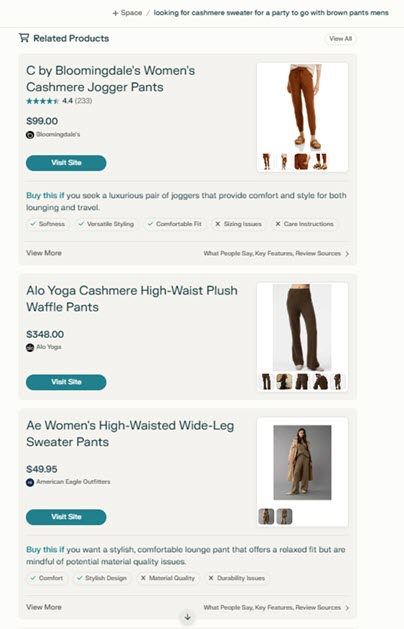
We started our test with a very simple query: “Looking for a cashmere sweater for a party to go with brown pants.” The first results were all the women’s pants!! We didn’t ask for pants; we asked for a sweater to go with pants. And none of the results had the option to Buy with Pro, only to visit the merchant’s website.
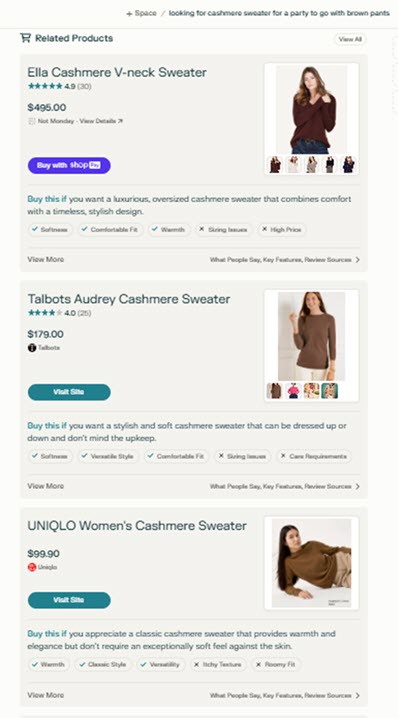
We started a new interaction with the identical prompt. This time, we received brown sweater suggestions, which is closer (do people wear brown sweaters with brown pants? maybe…), but still all women’s styles, while our user profile is configured as a male. So we should be receiving suggestions for men’s sweaters. Again, there were no Buy with Pro options, but we did find a Buy with Shop Pay option this time. Clicking the button brings the user to the Seller’s Shopify store directly to the checkout page to complete the purchase outside the Perplexity environment.
Looking for a New 3PL? Start with this Free RFP Template
Cut weeks off your selection process. Avoid pitfalls. Get the only 3PL RFP checklist built for ecommerce brands, absolutely free.
Get My Free 3PL RFPOn the third attempt, we appended the word ‘mens’ to the end of the prompt. This time, the results were mostly what we would expect, besides disagreement about what color sweaters would go with brown pants, though there was still no Buy with Pro option.
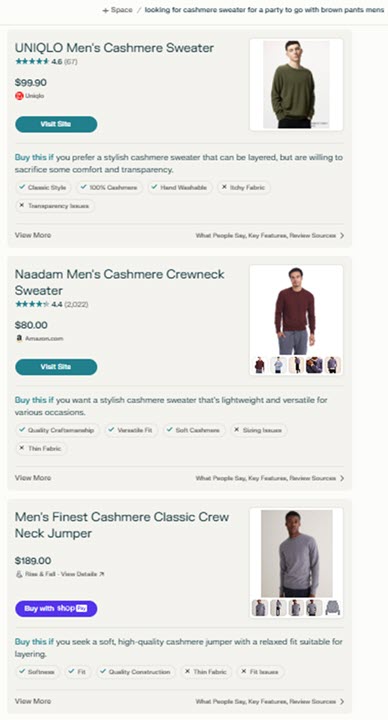
Perplexity Missed the Mark
While this use case for GenAI seems to be a natural fit for GenAI technology, it’s missing the mark. Search results were poor in our tests, suggesting product-market fit might be a long way away. The current solution lacks enough data or the needed intelligence or context.
We’re optimistic about the future of this technology, but in our limited trial/quick test, we weren’t impressed. Generative AI should be able to understand our profile and what we’re looking for and return a men’s sweater and not pants.
Scaling Made Easy: Calis Books’ Fulfillment Journey
Learn how Calis Books expanded nationwide, reduced errors, grew sales while cutting headcount, and saved BIG with Cahoot
See Scale JourneyIt Ain’t All Bad
While search results for the sweater didn’t deliver against expectations, the results did include some thoughtful suggestions about shades and tones to consider for different looks that the shopper might be interested in achieving, as well as tips for accessorizing the outfit:
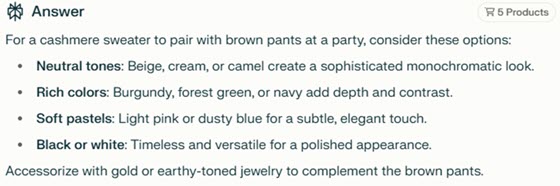
So, there is promise, but is the product ready? We don’t think so. Again, it’s early, and this was our first couple of queries. But for paid Perplexity Pro users, that’s their first impression, and Shoppers will be disappointed, and Shoppers are very discerning.
Final Thoughts on Perplexity
Perplexity is still a young startup and may figure it out. But trying to compete with the OpenAI’s of the world and launching products prematurely may be a bad idea.
Whether expanding from the Shopify partnership to increase the scale of Buy with Pro or working on understanding the queries better and returning better results, the next move should be figuring out and bridging the gaps. In the era of AI, capturing interest and early users for only $20/month is the easy part. Keeping them, not so much. You can also listen to a recent Perpelixty AI Commerce Search podcast here .
Written By:
Indy Pereira
Indy Pereira helps ecommerce brands optimize their shipping and fulfillment with Cahoot’s technology. With a background in both sales and people operations, she bridges customer needs with strategic solutions that drive growth. Indy works closely with merchants every day and brings real-world insight into what makes logistics efficient and scalable.
Turn Returns Into New Revenue
Related Articles
Retail Supply Chain & Logistics Expo New York 2026
September 30-October 1, 2026 | New York, NY Retail Supply Chain & Logistics Expo New York brings together retailers, ecommerce brands, online sellers, supply chain leaders, log...
Outliers Summit 2026
Nov 5–6, 2026 | NEW YORK, NY Outliers Summit brings ambitious founders, builders, creators, operators, and investors together in New York City for two days focused on building and ...
The Lead Summit 2026
May 20-21, 2026 | New York, NY The Lead Summit 2026 brings brand builders, retail leaders, and senior innovators together for two days in New York focused on what’s next for commer...
Turning Today’s Smart Shoppers into Loyal Customers
When you ring up a sale with a brand new customer, whether online or in a store, is that the end of the relationship? Or is it just the beginning? In her best-selling book “The Membership Economy,” Robbie Kellman Baxter makes a clear case for the latter. The economics are profound, as it costs 7x more to acquire a new customer than to earn a repeat visit.
Brand loyalty is the key to growth for almost all retail categories. Whether your business relies heavily on repeat visits (e.g. sports apparel stores) or on low frequency purchases (e.g. a wedding reception decorations retailer), brand loyalty matters. You’d love for that soccer aficionado to shop every season. And you’d love for a recent bride to recommend your store, whether online or brick & mortar, to her friends when the time comes.
You build loyalty through great shopping experiences and customer touch points. One hundred years ago, those experiences began in stores, through interactions with store associates. And they continued with ongoing personal relationships. People’s lives centered on relatively small geographic areas, and retailers learned about their customers in person. Today, we are a mobile society. Store associates aren’t lifetime employees, and loyal shoppers visit multiple locations of their favorite retailers, including online.
The proliferation of customer touch points during the past 20 years has been immense. Meanwhile, your ability to truly know your customers, and how they interact with you, has become near impossible. Consider a shopper who just walked into one of your stores. Imagine if store associates knew the answers to all of these questions:
- Did she do any research before walking in? What products was she browsing?
- Has he shopped here previously? What did he buy and what brands does he like most?
- How happy was she with her last purchase here? Has she returned anything?
- Has he purchased from us online? Was it from our site? Or from a marketplace?
- Does she talk about our category, or about us, on social media?
- Have we interacted with him after the sale? Live chat? Contact Center? Chat bots?
Slash Your Fulfillment Costs by Up to 30%
Cut shipping expenses by 30% and boost profit with Cahoot's AI-optimized fulfillment services and modern tech —no overheads and no humans required!
I'm Interested in Saving Time and MoneyYour customer is capable of remembering all of it. And increasingly, as shoppers, they expect you to remember too — to know them across all the touch points they’ve experienced with you. And while technology is the driver behind channel proliferation, technology has not kept up with your need to know about all of those new types of interactions as your customers move from your site, to your store, to the telephone contact center. And back to the store again.
In this whitepaper, we will explore the challenges that retailers face in delivering omnichannel customer satisfaction as well as the solutions.
We will follow customers along the buyer journey.
How can you treat individual customers consistently, as if your brand truly knows them, regardless of whether they are on social media, buying on a marketplace, or in your store? And given that we can’t possibly know every single touch point, how can we, at a minimum, intelligently ensure that every interaction that customers have will be positive.
We will also, for many of the touchpoints within each step, cover the foundational capabilities you need in place, as well as those that will help you achieve omnichannel excellence.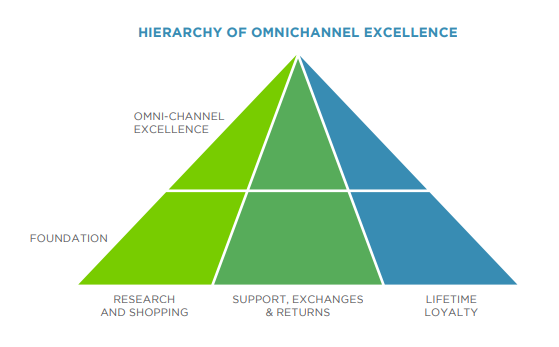
Customer Loyalty Building Blocks
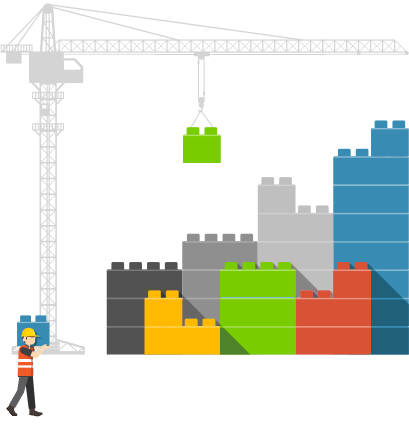
Intuitively, if you’re a retailer, you know that loyalty begins with the basics. Customers have needs, and they come to you to buy the products that will satisfy those needs.
- “I’m having a wedding, and I need party favors.”
- “Soccer season begins in 3 weeks, and I need practice gear.”
- “We’re headed to Mexico for the winter holiday, and I need SPF 30 swimwear.”
Looking for a New 3PL? Start with this Free RFP Template
Cut weeks off your selection process. Avoid pitfalls. Get the only 3PL RFP checklist built for ecommerce brands, absolutely free.
Get My Free 3PL RFPThe Basics
As a retailer, you help shoppers find the products that will make them happy, and you make the purchase process as easy as possible. You deliver where and when you promised you would. And, if your new customer has questions, or wants to return or exchange a product, you answer their questions quickly and make returns and exchanges simple too. You might even go a step further, with a basic loyalty program that rewards purchases.
Except, the basics aren’t simple anymore, because at every step of the buyer journey, customers are not just changing lanes on the highway, they’re switching from planes, to trains to automobiles… to SpaceX (see figure 1).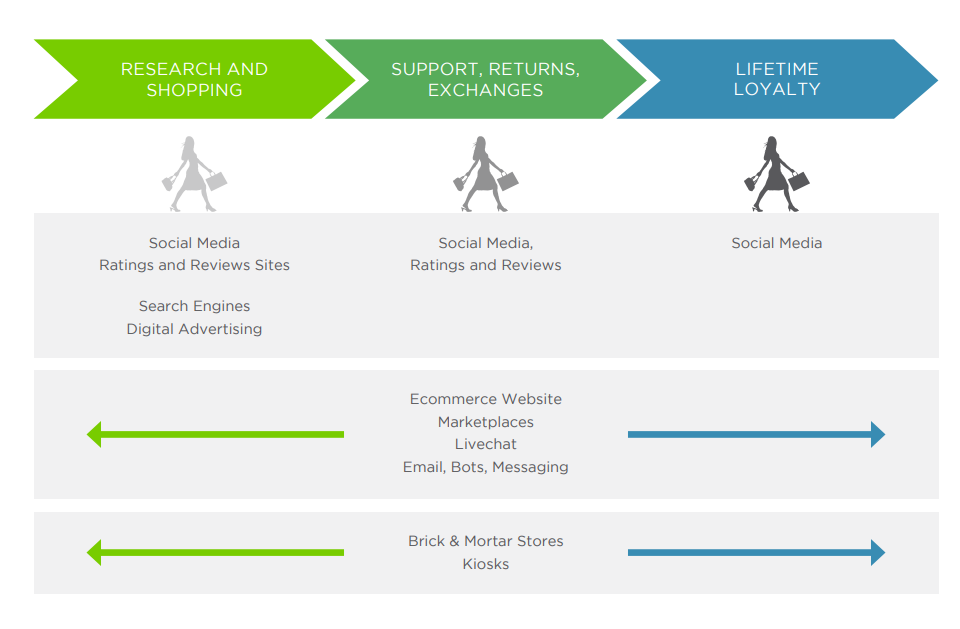
Shopping and Research
To serve your well-informed customers better, you need to know what they know. Before entering the store, what did they learn from google searches, reviews, twitter and your Facebook page? How does pricing and return policy vary between your ecommerce site, marketplaces, and your stores? Are your contact centers giving the same answers to the same questions as your live chat operators and your store associates?
Support, Returns & Exchanges
Return and exchange policy and execution are two of the most important factors consumers consider when choosing a retailer – whether buying online or in stores. In fact, according to the UPS Pulse of the Online Shopper™ study, 66% of shoppers review a retailer’s return policy before making a purchase. At a minimum, this must be a simple process. More advanced retailers are enabling customers to buy, modify an order, return and exchange across multiple contact channels. The easier we make it for customers, the more likely they are to return.
- Are each of your channels providing great support?
- Are they able to interact with a customer the same across all channels?
- Or is your company treating one customer like three:(1) the store customer, (2) the website customer, and(3) the call center customer?
Lifetime Loyalty
Loyalty programs are everywhere we turn. From buy 10, get 1 free punch cards, to rewards points, to discounts off the next purchase, retailers are in an arms race to keep customers coming back. And loyalty programs help you get to know your customers better too. Are you keeping your customers engaged with your brand after they walk out with their first purchase?
Scaling Made Easy: Calis Books’ Fulfillment Journey
Learn how Calis Books expanded nationwide, reduced errors, grew sales while cutting headcount, and saved BIG with Cahoot
See Scale JourneyThe Basics Matter
While there are a myriad of initiatives within each loyalty driver that we can enhance, retailers ignore the basics at their peril:
- 89% of customers have stopped buying from online stores after they’ve experienced poor service (source: Right Now)
- A 5% reduction in customer abandonment rate can increase profitability by 25% – 125%. (Source: “Leading on the Edge ofChaos,” Murphy & Murphy)
Written By:
Indy Pereira
Indy Pereira helps ecommerce brands optimize their shipping and fulfillment with Cahoot’s technology. With a background in both sales and people operations, she bridges customer needs with strategic solutions that drive growth. Indy works closely with merchants every day and brings real-world insight into what makes logistics efficient and scalable.
Turn Returns Into New Revenue
Related Articles
Retail Supply Chain & Logistics Expo New York 2026
September 30-October 1, 2026 | New York, NY Retail Supply Chain & Logistics Expo New York brings together retailers, ecommerce brands, online sellers, supply chain leaders, log...
Outliers Summit 2026
Nov 5–6, 2026 | NEW YORK, NY Outliers Summit brings ambitious founders, builders, creators, operators, and investors together in New York City for two days focused on building and ...
The Lead Summit 2026
May 20-21, 2026 | New York, NY The Lead Summit 2026 brings brand builders, retail leaders, and senior innovators together for two days in New York focused on what’s next for commer...
Retailers Need a 360-degree Customer View to Win: Turning Today’s Smart Shoppers into Loyal Customers
Why Retailers Need a 360-degree Customer View to Win in the Omnichannel Age
Introduction
When you ring up a sale with a brand new customer, whether online or in a store, is that the end of the relationship? Or is it just the beginning? In her best-selling book “The Membership Economy,” Robbie Kellman Baxter makes a clear case for the latter. The economics are profound, as it costs 7x more to acquire a new customer than to earn a repeat visit.
Brand loyalty is the key to growth for almost all retail categories.
Whether your business relies heavily on repeat visits (e.g. sports apparel stores) or on low frequency purchases (e.g. a wedding reception decorations retailer), brand loyalty matters. You’d love for that soccer aficionado to shop every season. And you’d love for a recent bride to recommend your store, whether online or brick & mortar, to her friends when the time comes.
You build loyalty through great shopping experiences and customer touch points.
One hundred years ago, those experiences began in stores, through interactions with store associates. And they continued with ongoing personal relationships. People’s lives centered on relatively small geographic areas, and retailers learned about their customers in person. Today, we are a mobile society. Store associates aren’t lifetime employees, and loyal shoppers visit multiple locations of their favorite retailers, including online.
The proliferation of customer touch points during the past 20 years has been immense.
Meanwhile, your ability to truly know your customers, and how they interact with you, has become near impossible. Consider a shopper who just walked into one of your stores. Imagine if store associates knew the answers to all of these questions:
- Did she do any research before walking in? What products was she browsing?
- Has he shopped here previously? What did he buy and what brands does he like most?
- How happy was she with her last purchase here? Has she returned anything?
- Has he purchased from us online? Was it from our site? Or from a marketplace?
- Does she talk about our category, or about us, on social media?
- Have we interacted with him after the sale? Live chat? Contact Center? Chat bots?
Your customer is capable of remembering all of it. And increasingly, as shoppers, they expect you to remember too — to know them across all the touch points they’ve experienced with you. And while technology is the driver behind channel proliferation, technology has not kept up with your need to know about all of those new types of interactions as your customers move from your site, to your store, to the telephone contact center. And back to the store again.
Looking for a New 3PL? Start with this Free RFP Template
Cut weeks off your selection process. Avoid pitfalls. Get the only 3PL RFP checklist built for ecommerce brands, absolutely free.
Get My Free 3PL RFPIn this whitepaper, we will explore the challenges that retailers face in delivering omnichannel customer satisfaction as well as the solutions.
Written By:
Indy Pereira
Indy Pereira helps ecommerce brands optimize their shipping and fulfillment with Cahoot’s technology. With a background in both sales and people operations, she bridges customer needs with strategic solutions that drive growth. Indy works closely with merchants every day and brings real-world insight into what makes logistics efficient and scalable.
Turn Returns Into New Revenue
Related Articles
Retail Supply Chain & Logistics Expo New York 2026
September 30-October 1, 2026 | New York, NY Retail Supply Chain & Logistics Expo New York brings together retailers, ecommerce brands, online sellers, supply chain leaders, log...
Outliers Summit 2026
Nov 5–6, 2026 | NEW YORK, NY Outliers Summit brings ambitious founders, builders, creators, operators, and investors together in New York City for two days focused on building and ...
The Lead Summit 2026
May 20-21, 2026 | New York, NY The Lead Summit 2026 brings brand builders, retail leaders, and senior innovators together for two days in New York focused on what’s next for commer...
3 Strategies to Fulfill Like Amazon
If Amazon reduced shipping costs by just 1 percent, it would save $162 million. Amazon spent $16.2 billion on shipping in 2016. We can be certain that it is spending millions to improve and optimize its shipping processes. Ecommerce merchants can take advantage of Amazon’s efforts to increase profits.
Amazon’s 2016 shipping expense was 17.7 percent of direct ecommerce revenue. That’s $8.85 for every $50 order, which is achievable by most merchants.
This post, describes three strategies to fulfill like Amazon, even if you have a fraction of its scale and infrastructure
- Manage Carriers
- Manage Yourself
- More Choices, Urgency
Manage Carriers
Manage carrier contracts by the numbers. Negotiate better rates using data and analytics.
Analyze accessorial charges. These are extra fees assessed on top of the base rate. Compare every accessorial line item, by carrier, as a percentage of total shipping costs.
- Errors, such as address correction, return charge, and incorrect weight.
- Extra services, such as residential or rural delivery, remote area delivery, and Saturday delivery.
- Surcharges, including fuel charges, hazardous materials and international dangerous goods, and holiday season surcharges.
Analyze standard shipping fees for each cost driver.
- Distance, weight, volume.
- Size to weight ratio — e.g., dimensional weight surcharges for light (but big) items.
- Service level — e.g., next day air versus 5-day ground.
Negotiate like a pro.
- Focus on the accessorial fees that have hit you the hardest.
- Negotiate shipping fees with each carrier to match the lowest priced carrier for each category.
- Negotiate insurance fees with each carrier as well as with pure-play insurers.
Enforce each carrier’s service level agreement and negotiated prices.
- Validate that carrier bills are indeed reflecting your negotiated prices.
- File timely reimbursement claims for SLA violations — within 15 days, typically.
Automate intelligent carrier and service selection. In my experience, companies can save up to 25 percent on shipping costs from this strategy alone. No single carrier offers the best rates for every situation. The carrier that charges the least for an in-zone ground shipment may not be the one that charges the least for a 2-pound next day air delivery.
Create decision rules for choosing carriers and service types based on factors such as dimensional weight and delivery zone. Rather than attempting to cover every possibility, start by implementing the rules for 80 percent of your orders. Make sure to meet the minimum volume that you promised a carrier to secure your discounts and negotiated rates.
Implement these intelligent rules across all fulfillment centers and drop-ship vendors and then automate the selection process for your entire order management and warehouse management systems. Here are two examples.
- Geography-based rules. Shipper A charges the least for shipments from New York to Arizona while Shipper B charges the least for same-zone shipments.
- Weight-based rules. Shipper C charges the least for next-day air packages under two pounds.
Slash Your Fulfillment Costs by Up to 30%
Cut shipping expenses by 30% and boost profit with Cahoot's AI-optimized fulfillment services and modern tech —no overheads and no humans required!
I'm Interested in Saving Time and MoneyManage Yourself
Like Amazon, audit and analyze your own operations routinely to deliver orders faster and cheaper. This may seem obvious, but many mid-market retailers lack the technology and infrastructure. Your ecommerce systems should facilitate automated rules, in addition to answering the following questions:
- Which products are generating the highest discrepancies between the shipping fee invoiced to the customer versus what’s charged by the carrier?
- What is the best carrier for each product, order size, and geography?
- Which shipments resulted in missed carrier SLAs or actionable exceptions?
Eliminate costly errors. Accessorial charges are typically the result of errors. According to Refund Logistics, 31 percent of carriers’ invoices include these extra fees, on average. Common errors and resulting fees include:
- Incorrect address, resulting in address correction and return fees.
- Incorrect dimensions and weight, resulting in DIM charges, which can be eliminated by ensuring product catalog data is accurate.
Intelligent order routing. Route orders to the fulfillment center(s) closest to the customer.
- Ship faster and reduce shipping costs up to 25 percent.
- Pick the least expensive shipping type that gets the package to its destination within the promised delivery date commitment.
Go omnichannel. If you’re an ecommerce merchant with physical stores, leverage those stores as fulfillment centers.
- Ship from store. Shipping from stores can reduce shipping costs and speed up delivery. For example, Best Buy reduced average shipping time by two days with its ship from store program. Revenue may increase, too, with this strategy. American Apparel reported a 30 percent increase in sales from using stores as backup fulfillment centers.
- Buy online, pick up in-store. Offer pickup in-store as a delivery option for online customers. It eliminates shipping fees and increases customer satisfaction. Plus, customers spend an additional 20 percent, on average, when picking up their items.
Looking for a New 3PL? Start with this Free RFP Template
Cut weeks off your selection process. Avoid pitfalls. Get the only 3PL RFP checklist built for ecommerce brands, absolutely free.
Get My Free 3PL RFPMore Choices, Urgency
Offer more choices. Increase conversions by giving customers delivery options that provide greater certainty of delivery times. For example, Amazon offers these shipping choices:
- “Tuesday, Sept. 12: $5.99 One-Day Shipping.”
- “Wednesday, Sept. 13: Free Two-Day Shipping.”
- “Friday, Sept. 15: Free No-Rush Shipping + Get $5 Reward for Prime Pantry.”
Create urgency to increase conversions. On your product details, shopping cart, and checkout screens, show how much time is remaining to complete the order and still receive guaranteed delivery by the desired date.
If you are already implementing these techniques and are looking for more tips and tricks, check out this comprehensive guide to profitable free shipping
Written By:
Indy Pereira
Indy Pereira helps ecommerce brands optimize their shipping and fulfillment with Cahoot’s technology. With a background in both sales and people operations, she bridges customer needs with strategic solutions that drive growth. Indy works closely with merchants every day and brings real-world insight into what makes logistics efficient and scalable.
Turn Returns Into New Revenue
Related Articles
The Lead Summit 2026
May 20-21, 2026 | New York, NY The Lead Summit 2026 brings brand builders, retail leaders, and senior innovators together for two days in New York focused on what’s next for commer...
Shopify DotDev 2026
July 21-22, 2026 | Toronto, Canada Shopify DotDev 2026 brings together developers, engineers, and technical partners from across the Shopify ecosystem for two days of deep technica...

Your Agentforce World Tour New York
Apr 29, 2026 | NEW YORK, NY Agentforce World Tour New York brings business and technology leaders together for a full day of sessions, demos, and hands-on training focused on Agent...
5 Ways to Improve the Parcel Delivery Experience
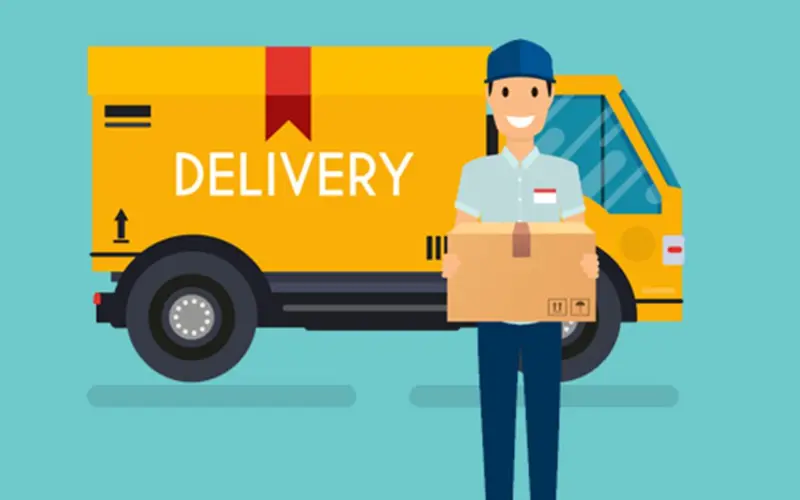
“The last mile” is now the Holy Grail of ecommerce shipping. A merchant can do an amazing job of selling and provide an outstanding shopping experience, yet if the package is late or damaged, a customer may complain on social media, even if the carrier is to blame.
You can’t directly control the last mile — i.e., the distance from a local transportation hub to the final destination — but you can improve the communication with your customer to provide excellent service, even when things go wrong.
Here are a few ways that merchants can provide an outstanding delivery experience and produce a positive brand impression.
5 Ways to Improve the Parcel Delivery Experience
1. Avoid porch pirates. Porch pirates are thieves that steal parcels from recipients’ porches. Many articles have been written about how to prevent this type of theft. Ideas include security cameras, lockers, and services like Package Guard, which notifies a recipient when a package is delivered.
But the most foolproof way to avoid theft is to ensure that the customer is home when the parcel arrives. Retailers can schedule delivery times and provide frequent delivery notifications (see 3., below), so consumers know when to be home. Saturday delivery options provide even more opportunities to stop package theft.
2. Provide delivery windows, with options. Customers expect tight delivery windows — ideally, 8 a.m. to 12 p.m. on a specific day, with notification an hour or so before delivery. Provide the ability for your customers to choose a delivery date and, if possible, a time.
Even better, empower them with different ways to receive packages. For example, Jet.com is installing Latch, a sophisticated access system, in 1,000 New York City apartment buildings for easier deliveries. Residents can use their phone as a key, grant access to guests without walking downstairs, and get packages delivered safely without being home.
Also, Amazon Locker is available to merchants using Fulfillment by Amazon. It is similar to a post office box, but only for Amazon deliveries. Customers get an email as soon as the package arrives at the locker and they have three days to pick it up. Similar services include FedEx Ship&Get, USPS Gopost, and UPS Access Point lockers.
Amazon is also testing delivering directly to customers’ car trunks, while Walmart is testing deliveries straight to customers’ refrigerators. Commitment to improving the last mile experience is immense. Independent merchants should not be too far behind.
Slash Your Fulfillment Costs by Up to 30%
Cut shipping expenses by 30% and boost profit with Cahoot's AI-optimized fulfillment services and modern tech —no overheads and no humans required!
I'm Interested in Saving Time and Money3. Send frequent delivery notifications via preferred mediums. Customers have their own preferred forms of communication. The more choices they have, the more likely they are to receive and read your updates. The top three consumer choices for communication are typically email, text message, and a company order-tracking page. As a start, offer all three.
Customers appreciate being notified when an order is going to ship, when it has shipped, where the item is currently located, and ongoing updates about the expected delivery date and time.
There are plenty of exceptions to these typical notices. You’ll earn loyalty points with your customers if you handle them well, and proactively. Examples include:
- Attempted delivery by the carrier, without success.
- Available for pickup at a carrier location, after too many attempted deliveries.
- Cannot schedule a delivery appointment, and the carrier is unable to reach the customer.
- Consignee refused delivery, usually because it was delivered to the wrong address.
- Other exceptions, including expected delays, package held at terminal, and incorrect address.
4. Provide a branded tracking page. A branded delivery-tracking page is a must have. Customers become increasingly engaged with your brand during the period between the purchase and delivery. According to the 2017 “Post-Purchase Benchmark Report” from Navar, a customer loyalty and retention platform:
- Those who track orders visit the tracking page 3.1 times per order.
- The click rate on marketing assets that appear on a branded order-tracking page is 3-times higher than for marketing emails
A branded tracking page will curtail “Where is my order?” customer-service queries. It will also provide your marketing team with better opportunities to cross sell, up sell, and boost engagement.
5. Offer branded and eco-friendly packaging. Branded packaging is a effective way to advertise. It’s similar to a mobile billboard. Remember the first time you saw a package from Jet.com? Or the ubiquitous Echo and Prime advertisements on every Amazon box? The more eye-catching your packaging is, the more your customers and their neighbors will remember it.
Eco-friendly packaging is becoming more important, especially for millennials. One recent study found that more than 50 percent of shoppers would pay more for environmentally friendly packaging.
Looking for a New 3PL? Start with this Free RFP Template
Cut weeks off your selection process. Avoid pitfalls. Get the only 3PL RFP checklist built for ecommerce brands, absolutely free.
Get My Free 3PL RFPExecution Is Key
Parcel delivery strategies are easy to articulate, but hard to execute well. Managing delivery in the last mile requires infrastructure for order and fulfillment that can track real-time package status from origin to the customer’s doorstep and everywhere in between. That information must sync with numerous platforms — website, customer support, email, text messages — and accommodate order and delivery modifications. Get it all right and you’ll have an unfair competitive advantage.
Written By:
Indy Pereira
Indy Pereira helps ecommerce brands optimize their shipping and fulfillment with Cahoot’s technology. With a background in both sales and people operations, she bridges customer needs with strategic solutions that drive growth. Indy works closely with merchants every day and brings real-world insight into what makes logistics efficient and scalable.
Turn Returns Into New Revenue
Related Articles
The Lead Summit 2026
May 20-21, 2026 | New York, NY The Lead Summit 2026 brings brand builders, retail leaders, and senior innovators together for two days in New York focused on what’s next for commer...
Shopify DotDev 2026
July 21-22, 2026 | Toronto, Canada Shopify DotDev 2026 brings together developers, engineers, and technical partners from across the Shopify ecosystem for two days of deep technica...
Your Agentforce World Tour New York
Apr 29, 2026 | NEW YORK, NY Agentforce World Tour New York brings business and technology leaders together for a full day of sessions, demos, and hands-on training focused on Agent...
7 Ways Retailers Can Make Free Shipping Profitable
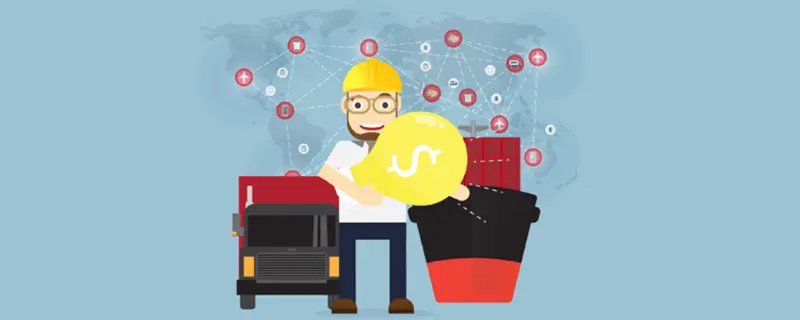
One of the most important and potentially expensive decisions that an online retailer can make is whether or not to offer free shipping. Over 2 million Google searches each month in the United States include the phrase “free shipping.” Most online merchants have at least considered offering it. It’s a tough decision because shipping is expensive — Amazon’s shipping expense was $16.2 billion in 2016, over 17 percent of its total order value.
How can a retailer afford an additional 15 to 20 percent expense?
The good news is that you can.
Begin with a simple A/B test, in which a random sample of shoppers — 10 to 50 percent — is offered free shipping. Compare the control group with the test group to see the change.
Then, track three outcomes to determine the real cost of offering free shipping.
- Change in conversion rate. For example, a change from 5 percent to 6 percent is a 20 percent increase, or 1.2 expressed as a decimal. In the equation below, it’s variable A.
- Change in average order value. An AOV improvement from $50 to $51 is a 2 percent increase, or 1.02 expressed as a decimal — variable B, below.
- Change in gross margins. If the control group gross margin is 50 percent, and the test group gross margin is 35 percent, then the gross margin decrease is 30 percent: -15% ÷ 50% = -30%.This is -0.3 expressed as a decimal. It’s variable C, below.
Slash Your Fulfillment Costs by Up to 30%
Cut shipping expenses by 30% and boost profit with Cahoot's AI-optimized fulfillment services and modern tech —no overheads and no humans required!
I'm Interested in Saving Time and MoneyNext, compute the percentage change in profit from offering free shipping, as follows.
% Change in profit (x) = [(A * B * (1+ C)) – 1] * 100
x = [(1.2 * 1.02 * (1 + (-0.3))) – 1] * 100
x = -14.3%
The change in profit from free shipping in this case is -14.3 percent.
What follows are seven strategies and tactics to turn free shipping from a -14.3 percent cost center into a profit increase.
7 Ways to Profit from Free Shipping
Set minimum order value. By adding a minimum threshold for free shipping, you can increase AOV because shoppers will have an incentive to increase basket size. You can also reduce the negative impact on margins because free shipping will be offered on fewer orders, and thus reduce situations where shipping cost represents more than 20 percent of the total order value.
Step 1: Choose a threshold. A good starting point is to add 10 to 15 percent to your current AOV. For example, if AOV is $50, offer free shipping on orders over $55
Step 2: Run the A/B test again. Your results could look like this:
- Conversion rate increased from 5 percent to 5.5 percent — 1.1, variable A.
- AOV increased from $50 to $57.50 — 1.15, variable B.
- Gross margin declined from 50 percent to 43 percent — -.14, variable C.
Now, the change in profit from free shipping is +8.8 percent:
% Change in profit (x) = [(A * B * (1+ C)) – 1] * 100
x = [(1.1 * 1.15 * (1 + (-0.14))) – 1] *100
x = 8.8%
Step 3: Supersize it. Adding a minimum of $55 for free shipping increases profit by 8.8 percent. Thus, we should heavily promote it. Here are three ideas.
- “You almost qualify.” When shoppers add an item to the cart, inform them how much more they need to spend to qualify for free shipping
- “Take advantage of your free shipping.” Once free shipping is earned, remind shoppers that they can take advantage of the free shipping to buy more.
- “Look how much you saved!” Remind shoppers at checkout how much money they are saving with free shipping
Looking for a New 3PL? Start with this Free RFP Template
Cut weeks off your selection process. Avoid pitfalls. Get the only 3PL RFP checklist built for ecommerce brands, absolutely free.
Get My Free 3PL RFPUse only ground shipping. Change the equation by offering free shipping only via your least expensive shipping option, such as USPS Flat Rate Boxes or UPS Mail Innovations. The promotion for this could be: “Free economy shipping on orders of $55 or more.”
According to 2017 survey by Internet Retailer and Bizrate Insights, nearly 90 percent of online shoppers say they are willing to wait longer for delivery of an order in exchange for free shipping. Most shoppers are likely to choose the free shipping option.
By using only ground shipping, you could cut your free shipping expense by more than half.
Offer low flat-rate shipping. Offer a flat-rate shipping charge on all orders. Amazon Prime Pantry does this well by leveraging consumer psychology to drive basket sizes up.
This approach has many advantages. Customers cover shipping expense on smaller, lower margin orders. Shoppers are incented to buy more, since additional items ship for free. As the order size increases, overall gross margin goes up, covering the incremental shipping cost.
Include shipping costs in product prices. Consider the effect on conversion rates from these two offers:
- Option 1: $30 + $5 shipping charge.
- Option 2: $35 with free shipping.
Bill D’Alessandro, of Rebel CEO, a consulting firm, ran this very test for a skincare product. The conversion rate for option 2 was twice that of option 1. This approach can work well for items that are unique and hard to price shop across multiple sites.
How do you include shipping costs in item prices? One approach is to change the pricing of items below the free shipping threshold to include a portion of expected shipping cost.
Say a merchant offers free shipping for orders of $75 or more. For a $25 item, add 33 percent ($25/$75) of the shipping cost to the item price. For a $10 item, add 13 percent ($10/$75) of the shipping cost to the item price.
The $25 item would now be offered at $28. The $10 item now has a price of $11.30. You still offer free shipping, but you’ll recoup a portion of the costs. Customers may prefer to pay $11.30 with free shipping versus $10 with $1.30 shipping.
Exclude items from free shipping. Reduce the negative margin impact of free shipping by:
- Offering free shipping only on high volume items with low shipping costs.
- Excluding low margin items from free shipping altogether.
- Excluding heavy and bulky items with high shipping costs from free shipping.
Scaling Made Easy: Calis Books’ Fulfillment Journey
Learn how Calis Books expanded nationwide, reduced errors, grew sales while cutting headcount, and saved BIG with Cahoot
See Scale JourneySubstitute service types. If you are offering free ground shipping, and charging an additional fee for expedited 2-day shipping, avoid displaying on your website the carrier name and specific service type that you intend to use.
In many cases, you’ll be able to use economical ground shipping to meet even the 2-day shipping requirements for expedited orders. For deliveries in close proximity to your distribution centers and drop shippers, for example, you can ship using the cheapest ground option and still meet the delivery window for some of your expedited 2-day orders and pocket the savings.
Sell via Amazon Prime and FBA. Gain access to over half of U.S. households by offering select products through Amazon Prime while using Fulfillment by Amazon to cut fulfillment costs. While FBA is certainly not free for merchants, some find that the efficiencies and volume gained through Amazon Prime and FBA can cover the cost of free shipping.
Not a Cash Sink
In short, free shipping doesn’t have to be a cash sink. Smart retailers of all sizes use free shipping as a lever to increase conversions and average order values while minimizing its negative impact on profits.
Moreover, free shipping can also reduce customer service costs for returns. Customers often request to be reimbursed for shipping when returning an item. But there’s nothing to reimburse on free shipping!
For more than 40 ways to reduce your shipping costs and be profitable, check out this ultimate guide to profitable free shipping.
Written By:
Indy Pereira
Indy Pereira helps ecommerce brands optimize their shipping and fulfillment with Cahoot’s technology. With a background in both sales and people operations, she bridges customer needs with strategic solutions that drive growth. Indy works closely with merchants every day and brings real-world insight into what makes logistics efficient and scalable.
Turn Returns Into New Revenue
Related Articles
Retail Supply Chain & Logistics Expo New York 2026
September 30-October 1, 2026 | New York, NY Retail Supply Chain & Logistics Expo New York brings together retailers, ecommerce brands, online sellers, supply chain leaders, log...
Outliers Summit 2026
Nov 5–6, 2026 | NEW YORK, NY Outliers Summit brings ambitious founders, builders, creators, operators, and investors together in New York City for two days focused on building and ...
The Lead Summit 2026
May 20-21, 2026 | New York, NY The Lead Summit 2026 brings brand builders, retail leaders, and senior innovators together for two days in New York focused on what’s next for commer...
7 Ways to Turn Post-Purchase Interactions into New Sales

Most retailers put a lot of time and effort into attracting new customers. It makes sense: you need customers to buy your products and sustain your business. However, generating more sales from existing customers is a more efficient, less expensive way to grow.
The probability of selling to an existing customer is 60 percent to 70 percent, compared with the 5 percent to 20 percent chance of selling to a new customer, according to the White House Office of Consumer Affairs.
Slash Your Fulfillment Costs by Up to 30%
Cut shipping expenses by 30% and boost profit with Cahoot's AI-optimized fulfillment services and modern tech —no overheads and no humans required!
I'm Interested in Saving Time and MoneyEvery dollar spent retaining or reselling goes further than one spent to attract new customers.
I invite you to reconsider the post-purchase customer as a prospect for continued, expanded business. In many ways, they’re an ideal prospect — you know what products they like, you know that they like your brand, and you have their trust.
Existing customers are also a great source of new prospects: 42 percent of online customers find recommendations from friends and family influential, and 23 percent are influenced by social media recommendations, according to BigCommerce’s Consumer Shopping Habits Study.
7 Ways to Turn Post-Purchase Interactions Into New Sales
The moment a customer completes a purchase, you should think of them as a new prospect, with opportunities for add-ons and additional sales on the horizon. Each interaction is an opportunity for more sales, more revenue per purchase, and more referrals.
1. Make good use of your order tracking page.
Between purchase and delivery, customers who track their orders visit the order tracking page an average of 3.1 times per order, according to the 2017 Narvar Post-Purchase Benchmark. They’re also three times more likely to click through a marketing asset on that page than a regular marketing email. Customers who visit the tracking page are excited about your products. Make good use of that prime real estate with targeted ads for products that would complement their recent purchase.
2. Answer their questions.
This might seem straightforward, but too many retailers are missing this crucial foundation. After purchase, customers expect you to be just as helpful as when you were trying to close the sale. At the simplest level, your website needs an easy-to-find FAQ about topics like shipping, refunds and exchanges.
Ideally, customers should be able to get an answer via any channel: phone, live chat, email, social media, or even in-store. According to Parature, 43 percent of customers cite being passed from agent to agent as a top aspect of bad customer service. Getting this right requires an an omnichannel order management system (OMS) that centralizes information for every agent. A customer standing in your store doesn’t want to hear that they have to call the 800 number, and now they won’t have to.
Looking for a New 3PL? Start with this Free RFP Template
Cut weeks off your selection process. Avoid pitfalls. Get the only 3PL RFP checklist built for ecommerce brands, absolutely free.
Get My Free 3PL RFP3. Order modifications: anywhere, anytime.
With the advent of sophisticated order fulfillment software, customers expect you to locate and modify their order right up until the moment it ships. Order management software can solve this challenge, integrated with OMS so that service representatives don’t have to call the warehouse to make changes.
It’s a worthwhile investment. When customers can modify their order, they’re more likely to buy add-ons, knowing that their products will arrive together. You also save on refunds and exchanges by eliminating shipping products that customers don’t want. Finally, you enhance your relationship with customers, who trust you to get them exactly what they want.
4. Provide smooth and easy returns.
Returns are unavoidable. According to the marketing experts at Invesp, 30 percent of products purchased online are returned. A full 35 percent of those returns aren’t due to any error, but just because a customer decided not to keep the item. Turn this potentially negative situation into an opportunity by delivering an outstanding, frictionless experience.
Customers want to return or exchange a product via any channel, not just the one where it was purchased. If they bring a sweater they purchased online into their local store, a store employee should be able to process the exchange, then delight the customer by offering the replacement item for pickup or quick shipment. An OMS makes this possible by centralizing all orders, inventory, fulfillment and returns.
5. Make it personal.
Once a customer purchases from your brand, you suddenly have an enormous marketing advantage: you know what they like. Fifty-nine percent of shoppers want personalized marketing online, including special offers, exclusive coupons or advertising for products they’re interested in, according to the Accenture Personalization Survey. Use what you know to market related products via email, direct mail, social media and other channels, and start soon after purchase while your brand is top of mind.
6. Don’t forget the packaging.
Let’s say that 20 percent of your customers open each of your marketing emails — pretty good! How many open the package that contains their order? More like 100 percent. Packing materials are an excellent marketing asset, and not to be overlooked.
Beyond the baseline — delivering the order on-time, complete and undamaged — you can delight customers with enclosed free samples or discount offers. Then make it easy for them to follow up. Set up a special short URL for the offer so they can place their order quickly while they’ve got it on their mind.
7. Get the most out of happy customers.
Loyal customers don’t only bring additional revenue, they can also bring in new customers. Consider implementing NPS, the simple survey that asks customers, “How likely are you to recommend this company to a friend?” Identify happy customers, then follow through: offer referral perks or encourage them to share their favorite products on social media.
Scaling Made Easy: Calis Books’ Fulfillment Journey
Learn how Calis Books expanded nationwide, reduced errors, grew sales while cutting headcount, and saved BIG with Cahoot
See Scale JourneyLoyalty programs are another great option, although they can be complex to administer. According to Accenture, members of loyalty programs generate 12 percent to 18 percent more revenue than customers who aren’t members. Loyalty programs keep customers actively engaged and drive repeat purchases, social media buzz and new referrals.
Conclusion
Getting the most out of your post-purchase customer interactions has two major parts: a well-designed and well-executed marketing strategy, and an omnichannel delivery and service commitment. Both pieces are necessary to drive higher customer retention, loyalty and referrals, and overall revenue. Businesses that adopt omnichannel strategies achieve over 90 percent greater year-over-year customer retention rates compared to those that don’t.
Written By:
Indy Pereira
Indy Pereira helps ecommerce brands optimize their shipping and fulfillment with Cahoot’s technology. With a background in both sales and people operations, she bridges customer needs with strategic solutions that drive growth. Indy works closely with merchants every day and brings real-world insight into what makes logistics efficient and scalable.
Turn Returns Into New Revenue
Related Articles
Retail Supply Chain & Logistics Expo New York 2026
September 30-October 1, 2026 | New York, NY Retail Supply Chain & Logistics Expo New York brings together retailers, ecommerce brands, online sellers, supply chain leaders, log...
Outliers Summit 2026
Nov 5–6, 2026 | NEW YORK, NY Outliers Summit brings ambitious founders, builders, creators, operators, and investors together in New York City for two days focused on building and ...
The Lead Summit 2026
May 20-21, 2026 | New York, NY The Lead Summit 2026 brings brand builders, retail leaders, and senior innovators together for two days in New York focused on what’s next for commer...